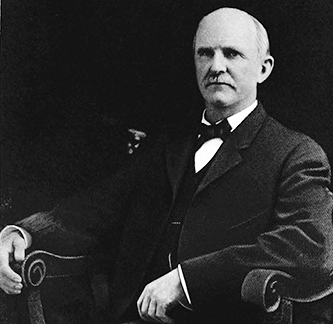
Pleasant Henderson Hanes, commonly known as P.H. Hanes, was born in Fulton, Davie County, North Carolina on October 16, 1845. He was the sixth of eleven children born to Alexander Martin Hanes and Jane March. His only formal education was in Fulton community schools, but Hanes’ help managing the family farm instilled in him the values of hard work, determination, and innovation. These early influences shaped Hanes’ future endeavors and entrepreneurial spirit.
Hanes ventured into the burgeoning tobacco industry in 1870 as a salesman for Dulin and Booe, eventually becoming a partner and moving to Winston. In 1872, he co-founded P.H. Hanes and Company with his brother, John Wesley Hanes. They quickly became one of the leading producers of chewing tobacco in the region, but ultimately sold the company to R.J. Reynolds in 1900 under pressure from James B. Duke’s American Tobacco trust.
1902 marked the beginning of a new era of entrepreneurship for P.H. Hanes. Although he could have easily retired on his tobacco profits, Hanes recognized potential in the textile industry. At age 56, he founded the P.H. Hanes Knitting Company with his two sons, Pleasant Huber and William Marvin. Their company set out to produce superior quality undergarments, with Hanes investing in state-of-the-art machinery and innovative manufacturing processes. Hanes first made two-piece, heavyweight underwear for men and boys.
P.H. Hanes’ leadership style was characterized by his forward-thinking approach and willingness to embrace new technologies. He understood the importance of modernizing production processes to stay competitive in the rapidly evolving textile market. Hanes was also known for his prowess as a salesman in particular. Hanes’ commitment to excellence and efficiency paid off, and P.H. Hanes Knitting Company produced over 1,000 garments a day in its early operations. The company became nationally recognized, and they provided millions of garments to the United States military during both World Wars.
P. H. Hanes’ two businesses significantly impacted the local economy, creating jobs and attracting other businesses to the Winston-Salem area. Hanes’ entrepreneurial success in the textile industry helped transform the city into a major center for textile manufacturing, stimulating economic growth and development in the region.
Hanes was a dedicated civic leader and investor in the community. He served multiple terms on the Board of Aldermen, a precursor to the city council, and was chairman of the Board of County Commissioners. Hanes also helped establish Winston-Salem’s first waterworks system and its graded school system. His penchant for technological advancement extended beyond his knitting company, being one of the first to introduce tractors to his farm west of the city. Hanes utilized modern agricultural strategies and encouraged others in the area to do the same.
Pleasant Henderson Hanes died on June 9, 1925. His P.H. Hanes Knitting Company merged with John Wesley Hanes’ Hanes Hosiery in 1965, marking the beginning of the Hanes Corporation. An undeniable leader in the global textile industry, both brothers’ individual success helped establish Hanes as a household name trusted by consumers everywhere. In 2005, the P.H. Hanes Knitting Company’s old mill complex downtown was listed on the National Register of Historic Places. P.H. Hanes’s legacy of innovation, leadership, and community service continues to thrive through the Hanes brand and the city of Winston-Salem.