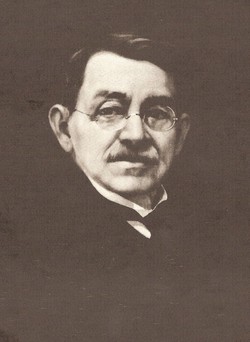
James Alexander Gray, Sr. was born in 1846 to Robert Gray and Mary Millis Wiley in Randolph County, North Carolina. When he was five years old, Gray and his family moved to the new town of Winston nearby. Raised there, Gray was educated at Salem Boys’ School and worked with his father at his dry-goods business. Gray went on to attend Trinity College, known today as Duke University, and married Aurelia Bowman in 1869 after meeting her at his sister’s college graduation.
When the president of the First National Bank of Salem died after about a decade in business, his nephew William Lemly closed the office and decided to relocate it to Winston. James Alexander Gray, along with Lemly and more business partners, established the Wachovia National Bank in 1879. Wachovia, the Latin form of the German name “Wachau,” refers to the tract of land in Forsyth County settled by the Moravians in the 1750s. Gray was the company’s first cashier and later served as president, totaling a tenure of 39 years.
With new legislation allowing for the creation of trust companies, the Wachovia Loan and Trust Company was established in 1893 (the first of its kind in North Carolina). The two enterprises eventually merged in 1910, three years before the towns of Winston and Salem merged. The new Wachovia National Bank and Trust Company was soon one of the largest banks in the South, in part due to its substantial accounts with R.J. Reynolds Tobacco Company.
Wachovia continued to innovate and grow throughout the 20th century thanks to the precedent set by James Alexander Gray. After his death in 1918, his family continued to be involved in the company and ensured its continued success. In 1964, Wachovia became the first bank in the Southeastern United States to exceed $1 billion in resources. The Wachovia Corporation was formed as a holding company in 1968, diversifying its operations and expanding its reach. Throughout the 1980s and 1990s, the introduction of interstate banking and banking deregulation allowed Wachovia to establish a presence in multiple states. Wachovia bought First Atlanta, the oldest national bank in Atlanta, Georgia, to form First Wachovia Corporation in 1985.
In 2001, Wachovia merged with Charlotte-based First Union Corporation, forming a new company that continued under the Wachovia name. This merger created the United States’ fourth-largest bank holding company, offering a broad range of banking, asset management, wealth management, and corporate and investment banking products and services. Wachovia was eventually acquired by Wells Fargo & Company in 2008, but its impact on the industry continues to be felt and would not have been possible without the leadership and vision of James Alexander Gray.
Gray was one of Winston-Salem’s wealthiest and most influential businessmen. His entrepreneurial success had a profound impact on the city, attracting other businesses and stimulating the local economy for decades to come. He was also dedicated to serving his community beyond Wachovia, however. He was the director of the Winston Water Company, and in civic affairs, he served on the school board, as town commissioner, and as city treasurer. Gray was an active member of the Centenary Methodist Episcopal Church and was treasurer of the Methodist Children’s Home. James A. Gray High School was named in his honor, now known as the North Carolina School of the Arts.
Gray was passionate about serving the greater Piedmont region as well. He was the director of the Roanoke and Southern Railway and devoted both time and money to his alma mater, Trinity College. He was a member of the Committee of Management with Julian S. Carr and John W. Alspaugh from 1885 to 1887, and he was a key figure in the school’s 1892 relocation from his birthplace, Randolph County, to its current campus in Durham. Today, the Gray Building at Duke Divinity School is named in his honor.
James Alexander Gray passed away in 1918 at his home on Cherry Street. He was predeceased by his wife Aurelia, with whom he had six children. Gray left behind an immutable legacy of innovation and philanthropy that continues through his descendants. His son Bowman Gray left $750,000 in his will to any local charitable endeavor, eventually becoming the Bowman Gray Center for Medical Education at Wake Forest University. His youngest son James Alexander Gray, Jr. also gave the school $900,000 of a $1.7 million trust benefitting various state universities and colleges. James Alexander Gray’s life and work embody the spirit of entrepreneurship and service that continues to thrive in Winston-Salem. The Gray family’s enduring legacy in Forsyth County and beyond cannot be overstated.