
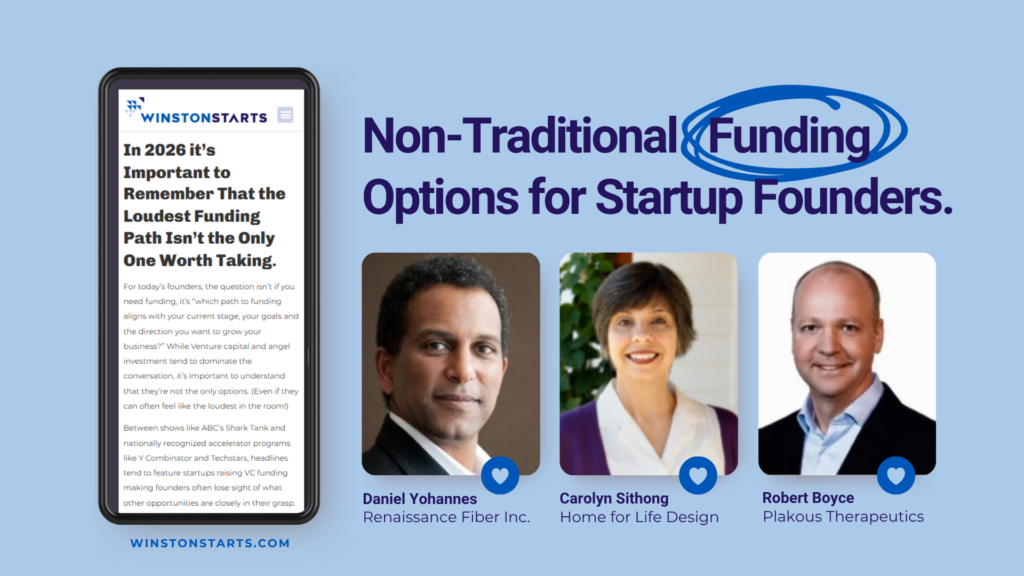
In 2026, it’s Important to Remember That the Loudest Funding Path Isn’t the Only One Worth Taking.
For today’s founders, the question isn’t if you need funding, it’s “which path to funding aligns with your current stage, your goals and the direction you want to grow your business?” While Venture capital and angel investment tend to dominate the conversation, it’s important to understand they’re not the only options. (Even if they can often feel like the loudest in the room!)
Between shows like ABC’s Shark Tank and nationally recognized accelerator programs like Y Combinator and Techstars, headlines tend to feature startups raising VC funding making founders often lose sight of what other opportunities are closely in their grasp.
At Winston Starts, we’ve seen firsthand that there is no one-size-fits-all approach to funding for Startups.
The right strategy depends heavily on the season your business is in and which specific challenges you’re working to solve. From early traction to scaling operations, founders in our entrepreneurial ecosystem have tapped into a variety of local and national resources to fund their growth—many of which don’t require giving up equity or chasing highly competitive investor pipelines.
For Carolyn Sithong, Founder and Chief Health Officer of Home for Life Design, non-traditional funding wasn’t just helpful, it was transformational.
Carolyn’s company, Home for Life Design, which provides data-driven home safety assessments to support independent living for aging and disabled populations, first received a MICRO grant from NC IDEA. This independent private, 501(c)(3) helps North Carolinians achieve their entrepreneurial ambition to start and grow high potential companies. NC IDEA fosters sustainable economic development with competitive grants and programs for entrepreneurs and funding to strengthen the North Carolina entrepreneurial ecosystem. Reflecting on that early support, she shares, “The MICRO grant was foundational to establishing the market fit for our product.”

That initial funding not only validated her concept but also challenged her to fully step into the role of founder. With guidance and accountability built into the process, Carolyn was able to strengthen her business and confidently pursue NC IDEA’s SEED grant. What stood out most wasn’t just the funding itself, but the belief behind it. “They believed in me and that made all the difference, so I jumped,” said Carolyn truly seeing that this route of funding wasn’t just financially beneficial but the intimacy of getting to know the organization and receive their encouragement was a huge benefit.
Her journey is a powerful reminder that non-traditional funding can offer more than simply capital, it can provide the structure, confidence, and momentum founders need to move forward. Carolyn’s advice comes from her own founder experience of pushing herself towards growth; “Do all you can to get non-dilutive funding at the start of your company and trust the process required to apply.”
$5M in Non-dilutive grant funding advanced both development and credibility for Robert Boyce‘s startup, Plakous Therapeutics.
One powerful example of non-traditional funding in action comes from Plakous Therapeutics, a Winston Starts company focused on advancing regenerative biotherapeutics to treat inflammation-driven diseases across all stages of life. Robert Boyce, CEO of the company proudly shared, “Plakous Therapeutics has secured roughly $5M in non-dilutive grants, primarily from the National Institute of Health (NIH) grants.
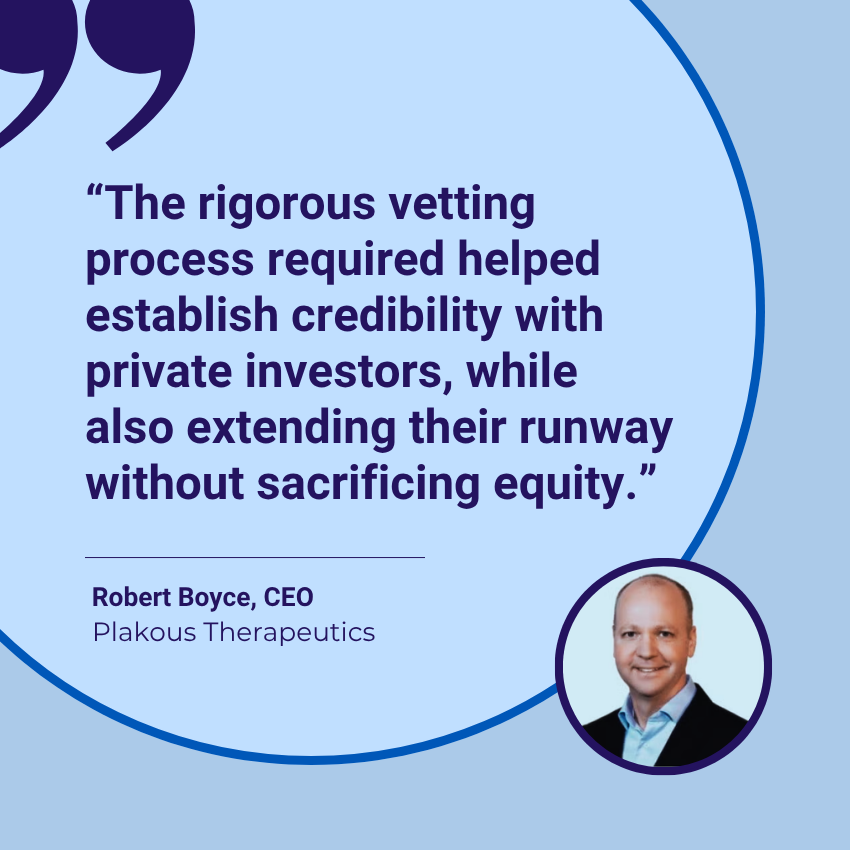
Beyond the financial support, these grants have done more than just fund progress—they’ve strengthened the company’s position in the broader investment landscape. “The rigorous vetting process required for NIH funding has helped establish credibility with private investors, while also extending our runway without sacrificing equity,” Robert remarked. This kind of funding is powerful for founders because it creates leverage, allowing companies like Plakous to continue advancing their development programs even through unpredictable investment cycles.
Robert’s experience highlights the advantage of government-backed funding: there are more opportunities available than many founders realize. It can take extra work to invest time into tracking and applying for the right programs, but the reward can absolutely be worth it!
Daniel Yohannes, founder of Renaissance Fiber, recently celebrated securing a $2M SBA-backed loan through a small regional bank.
Renaissance Fiber is a clean-tech manufacturer building a more sustainable future for textiles through US-grown hemp fiber and is yet another example of a startup taking a less conventional route to funding. Focused on creating a low-impact, carbon-sequestering supply chain, the company recently secured their $2 million SBA-backed loan through a small regional bank which many early-stage founders might overlook. As Daniel shared, “This route is a relatively non-traditional path for a startup since most founders pursue venture capital first, not bank financing.”
Rather than waiting on equity investment, the loan allowed the team to acquire equipment and begin building real production capacity, positioning them with stronger traction ahead of future raises. Daniel explained that the opportunity itself came through trusted connections, with their existing angel investors introducing them to an SBA loan aggregator, opening the door to a scalable financing pathway.
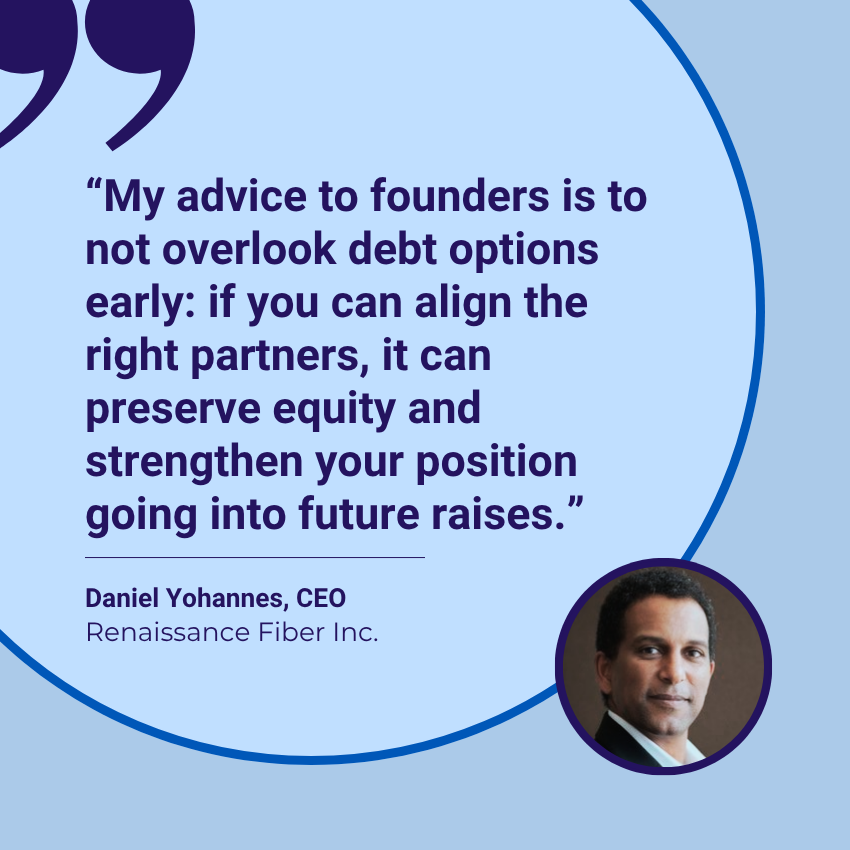
“My advice to founders is to not overlook debt options early. If you can align the right partners, it can preserve equity and strengthen your position going into future raises,” shared Daniel.
Funding a startup isn’t just about access, it’s about alignment.
Winston Starts sees firsthand that financial support for founders across the Triad, North Carolina, and the broader Southeast, remains one of the most critical pieces for them to build a sustainable business. As startups pave their path to success, they have the power to find support outside of the most traveled route. By exploring non-traditional funding options and learning from those who have successfully navigated them, founders can uncover a variety of opportunities that help fuel their finances and the support they deserve.